
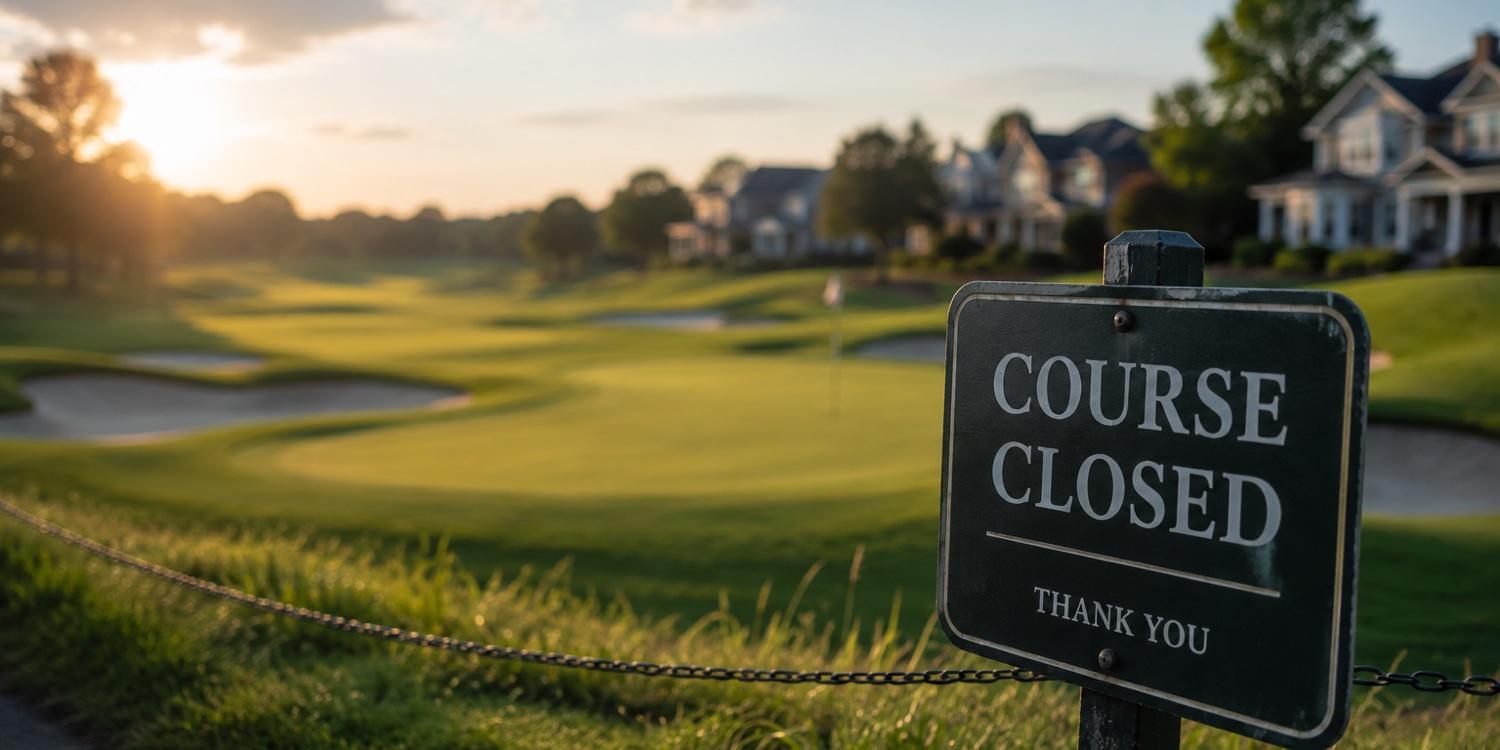
You bought the house on the fourteenth fairway. You paid a premium for it, because everybody pays a premium for it. Wide open view, mature trees, mowed grass to the horizon, no neighbor behind you.
Then the course closes. Now you own a house facing sixty acres of weeds that somebody else owns and has no obligation to mow, and a developer is at the county asking to put townhomes on it.
This happens. It has happened enough times that it is a recognized category of litigation, and it is the single largest risk in golf community ownership that buyers almost never price in.
Why courses close
The game overbuilt. Through the 1990s and into the early 2000s, courses went up at a pace the golfing population never justified, and a large share of them were built primarily to sell real estate. The course was a marketing expense. Once the lots were sold, the marketing expense still needed mowing every week.
The National Golf Foundation has counted more closures than openings in the United States in most years since the mid 2000s. The game has been healthy on the participation side in recent years, which has slowed the bleeding considerably, but the correction is not finished and it was never distributed evenly. Markets with too many courses chasing too few rounds are still working it out.
The economics are unforgiving. A course needs somewhere in the range of 25,000 to 40,000 rounds a year to work as a daily fee operation, more if the land is valuable and the taxes are high. Water is expensive and getting more so in the West. Labor is expensive everywhere. Meanwhile the land underneath a 150 acre course in a built out suburb may be worth more with houses on it than it can ever earn with grass on it.
That gap is the whole risk. When the land is worth more dead than alive, somebody will eventually notice.
What it does to your house
The research and the litigation record point the same direction. Homes directly on a closed course lose value, and the loss is concentrated on the frontage lots that paid the biggest premium going in. Interior homes in the same community fare better but do not escape it, because the amenity that defined the neighborhood is gone.
Then it gets worse in a specific way. A closed course is not a park. It is private land owned by somebody with an economic problem, and their solution is usually to develop it. So the fairway view becomes a construction site, and the homeowners spend the next several years and often several hundred thousand dollars in legal fees fighting rezoning at county commission meetings.
Sometimes they win. Deed restrictions, plat notes, or conservation easements can genuinely limit what gets built, and courts have enforced them. Sometimes they lose, because the documents only ever said the land was zoned for recreation and zoning can be changed by the same body that set it.
Either way, the years spent finding out are not pleasant, and they happen during the part of life you moved there to enjoy.
The tell: who owns the course
This is the question that separates high risk from low risk, and it takes one phone call.
If the members own the course, closure risk is much lower. Members do not vote to close their own golf course. They will assess themselves, cut the budget, sell a maintenance parcel, and grind through bad years before they shut it down, because they live there and the course is why.
If a third party owns it, a management company or an investor or the original developer, the course is an asset on somebody's balance sheet. It gets evaluated against alternatives. That owner has no obligation to keep losing money so your view stays green, and no obligation to sell it to you at a price you like.
If the course is public or semi private and depends on outside play, it is exposed to the health of the whole regional market rather than just your community.
None of these is disqualifying. A well run investor owned course in a strong market is a fine thing to live on. But you should know which one you are buying, and price the risk accordingly.
How to judge the risk before you buy
Ask for rounds played, annually, for the last five years. This is the vital sign. A course doing solid volume with a stable or growing member roster is not closing. A course whose rounds have fallen every year for five years is telling you exactly what it is going to do eventually.
Look at what surrounds the property. A course ringed by expensive residential land in a growing metro carries more development pressure than one out where the land has no better use. Perversely, the more desirable the location, the higher the closure risk, because the alternative use is worth more.
Count the competition. If there are eleven courses within twenty minutes and the market only supports eight, some of them are going to lose, and you want to know whether yours is among the strong ones.
Check the maintenance. Deferred maintenance is how a course dies, slowly and then quickly. Bunkers with washed out sand, thin greens, cart paths breaking apart, roughs that are not being mowed on schedule, a shrinking maintenance crew. Play it on a weekday morning and look past the first tee.
Read the deed restrictions and the plat. Find out whether the course land carries any recorded restriction on use, and how strong it is. Have your attorney do this. A conservation easement is real protection, a note on a plat map from 1994 may not be.
Ask the county about the zoning and whether any change has been requested. This is public record and it is free.
The premium question
Frontage lots cost more. Sometimes a great deal more, and the view is genuinely worth something on the mornings when the fog sits in the low ground and nobody is out yet.
Just go in knowing what you are paying for. You are buying a view you do not own, on land somebody else controls, subject to an economic model that has been under pressure for two decades. On a healthy member owned course in a market with the right number of courses, that is a reasonable bet and I would make it. On a struggling investor owned course surrounded by land worth four times what the course earns, you are paying a premium for the thing most likely to be taken away.
The interior lot two streets back does not have the view. It also does not have the exposure, and it will hold value better if the worst happens.
What to do about it
Play the course on a Tuesday, ask the pro shop how many rounds they did last year, and ask who owns the place. Three questions, one visit. Then have an attorney read the deed restrictions on the course parcel before you close on the house that faces it.